YouTube Numbers Dropping? Gather Evidence and Demand Independent Accountability

By Chris Porter | Jamaican Young Police | Special Report & Commentary
Your work has value—and your evidence matters
Imagine watching years of your work disappear from a dashboard—and then struggling to get somebody to explain what happened. You built the channel. You bought the equipment. You researched the stories. You stayed awake editing while other people were sleeping.
Then you open YouTube Studio, and something looks terribly wrong. Your numbers are collapsing. Your earnings are falling. You document discrepancies, contact support, and ask specific questions—but the response leaves you feeling as though somebody is telling you that what you recorded is a figment of your imagination.
American creators, hear me carefully: you do not have to surrender your right to question a powerful corporation. But your strongest weapon is evidence. A falling number deserves investigation. Establishing deliberate wrongdoing requires proof.
That is why you must preserve your records, demand written explanations, seek qualified legal advice, and take documented concerns to your elected representatives. The United States Congress—the House of Representatives and the Senate—should consider legislation establishing independent oversight of major platforms’ creator accounting and complaint systems.
If the records are accurate, independent examination should help establish that. If mistakes occurred, creators deserve corrections. If unlawful conduct occurred, there should be consequences. We cannot build a fair digital economy on the hope that every corporation will voluntarily do the right thing.
Honesty should be an enforceable expectation. Accountability should have a process. Your work has value. Your time has value. Corporate size should never place a company beyond scrutiny. Substance over popularity—and remember: data is king!

Editorial illustration: this evidence-gathering graphic is a conceptual design, not an actual channel analytics record.
Why creators deserve meaningful explanations
My fellow creators, there is something deeply troubling about depending on a system that can affect your livelihood while leaving you struggling to understand its decisions. You can see what your dashboard displays. You can see what reaches your bank account. You can document what changed.
But when you ask why, you may find yourself moving through support messages without receiving an explanation that addresses your evidence. For someone who treats YouTube as a business, that uncertainty matters.
Equipment costs money. Internet service costs money. Research takes time. Editing takes time. Building an audience can take years. So when a creator raises a serious accounting concern, that concern deserves careful examination.
Today, I am calling for an organized response: preserve the evidence, pursue the appropriate legal remedies, and ask Congress to create stronger, independent protections for creators.
1. Make your evidence stronger than your frustration
If you believe your channel numbers are changing improperly, begin with a record somebody else can examine. Capture the screen. Record the date and time. Identify the video. Show the metric, the reporting period, and the filters you selected.
Was the number views, impressions, subscribers, estimated revenue, or a finalized payment? Those are different measurements. Your evidence must identify precisely what you are challenging.
Keep the original screenshots and recordings. Export the available analytics. Preserve payment statements, policy notices, support conversations, and case numbers. Create a timeline that tells the story clearly.
On this date, the dashboard displayed this figure. Later, the same report displayed another figure. Here is the original record. Here is the question I submitted. Here is the response. That is how you turn an upsetting experience into a complaint that can be investigated.
Preserve records that might challenge your theory, too. A serious investigation follows the evidence wherever it leads. Your credibility becomes stronger when you demonstrate that you want an accurate answer.

Editorial illustration: the screen, numbers and documents shown in this design are illustrative. Preserve your own original reports as evidence.
2. Investigate possible explanations
YouTube says that invalid traffic can lead to adjustments affecting views and earnings, limits on advertising, and offsets against an AdSense for YouTube balance. These are explanations the company publicly identifies. They do not establish what happened to any particular creator.
If the company says an adjustment explains your loss, ask how that explanation applies to your records. Which reporting period was affected? Which metric changed? Was a payment adjusted? Was a policy applied? Was a technical problem identified?
Also check whether you are comparing the same things. A rolling reporting window can change as earlier activity leaves the window. Different date ranges can produce different totals. Estimated earnings and completed payments should be examined separately.
Your investigation should account for those possibilities before reaching a conclusion. That discipline helps you ask a more powerful question: I understand that legitimate adjustments can occur. Please explain the documented discrepancy in this particular report.
A company should be able to distinguish between protecting sensitive systems and giving a business partner a meaningful explanation. Creators can reasonably seek answers without demanding details that would help people defeat fraud detection.
3. Put the dispute in writing
A scattered collection of angry messages is difficult to evaluate. Prepare one organized complaint. Identify your channel and the affected videos. Describe the discrepancy. State when it began. Attach a few clear examples. Explain what you have already checked.
Then specify the remedy you are requesting. Perhaps you want an accounting reconciliation. Perhaps you want a technical investigation, a payment correction, or a written explanation of an adjustment. Ask for a substantive response within a reasonable period. Keep proof that you submitted the complaint.
If support replies with a general explanation, respond professionally: Thank you. Please explain how that policy accounts for the attached records. Stay focused on the unresolved question. There is power in being calm enough to remain precise.
You do not need to insult a support employee to establish that a response failed to address your evidence. Quote the question, identify the missing answer, and preserve the exchange. That record may later matter to a lawyer, a regulator, or a congressional staff member.
4. Seek legal advice and use the courts properly
Yes, creators can explore legal remedies against powerful companies. But a lawsuit requires a factual and legal foundation. Wanting answers, by itself, does not establish a valid claim.
Ask a qualified attorney to review your evidence, the applicable agreements, the deadlines, and the available forum. Ask whether your records support a claim and what it would cost to pursue it.
The federal courts explain that a civil complaint must describe the injury, connect it to the defendant, establish the court’s jurisdiction, and request relief. Relevant evidence may be exchanged through discovery, subject to the applicable rules and court decisions. Filing a lawsuit does not guarantee access to every internal record.
The court process can provide a lawful way to test supported allegations. It should be approached with preparation and realistic expectations. Bring your attorney a useful file: the timeline, the agreements, the original analytics, the correspondence, and a careful calculation of the loss you claim.
Keep actual losses separate from projections. Explain your assumptions. Identify gaps. Remember that delivering a demand letter, serving legal papers, winning a case, and collecting a judgment are different events. Each has its own significance. Describe your progress accurately.
Corporate power should never discourage a creator from seeking legal advice. Preparation gives that advice something solid to work with.

Editorial illustration: Data Is King is a call to document discrepancies and seek answers; the displayed chart is not evidence of wrongdoing.
5. Bring the policy problem to Congress
Contact your member of the House of Representatives and both senators from your state. Official House and Senate websites provide ways to identify and contact those offices.
Lead with a brief, organized account: I am a constituent and an online creator. My business depends on platform reporting. I have documented discrepancies that remain unresolved, and I am requesting attention to creator accounting transparency and independent dispute review.
Attach a short timeline and a few examples. Offer the fuller record if requested. Then make a specific legislative request. Ask for hearings on creator accounting and complaint handling. Ask lawmakers to examine whether existing remedies are accessible to small creators.
Ask them to consider enforceable standards for explanations, record preservation, independent audits, and appeals. A congressional office cannot promise you views or decide your private lawsuit. But lawmakers can consider whether the rules governing this part of the economy adequately protect the people earning their living within it.
6. A proposal for independent creator oversight
This is a proposal for reform. Congress should consider establishing an independent digital creator accountability body, with clearly defined authority over major platforms’ financial reporting and related dispute processes.
Its purpose should be practical: examine whether reported figures and payments are handled according to applicable obligations, investigate supported complaints, and help correct established errors.
It should have technical expertise. People reviewing disputed metrics need to understand data systems, advertising, accounting, statistical uncertainty, and the difference between an estimate and a completed transaction.
It should have independence. A review process needs safeguards against control by the companies it examines. Leadership, funding, conflicts of interest, and public reporting should all receive careful attention.
It should have a defined process. Creators should know what evidence to submit, when to expect a response, how a decision will be explained, and how to challenge a mistake.
It should have safeguards for everybody involved. Viewer privacy matters. Legitimate trade secrets matter. Fraud prevention matters. Platforms should also be able to respond to allegations and challenge incorrect findings. A fair system must test claims impartially.
Where sensitive information cannot be published, authorized independent reviewers could examine it under appropriate confidentiality protections. That gives us a constructive answer to the familiar problem: the creator needs verification, while the platform says the underlying details are sensitive. Independent examination can help bridge that gap.
7. Define fairness clearly
No oversight body can make every video successful. Audience interest changes. Advertisers make different decisions. Channels compete for attention. The protections we seek should concern accurate reporting, compliance with applicable obligations, understandable explanations, and meaningful remedies when errors or violations are established.
A creator should be able to say: I accept that my next video may perform differently. I still expect the reporting and payments associated with it to be handled properly. That is a reasonable position.
A small creator should have access to a workable complaint process. If challenging a modest accounting loss requires spending far more than the amount in dispute, many people will understandably give up. Congress should examine whether an affordable independent review process could address that problem. Rights become more useful when ordinary people can afford to exercise them.
8. Organize around shared standards
If others describe similar problems, compare the records carefully. Were the same metrics involved? Did the changes happen during the same period? Were the reporting settings comparable? Did the creators receive the same explanation?
Shared experiences can identify questions worth investigating. Consistent documentation helps determine whether a broader pattern exists. Build a responsible creator coalition. Agree on a simple reporting format. Protect private information. Keep allegations clearly distinguished from findings.
Creators do not have to agree about politics, religion, comedy, or current affairs to support accurate accounting. An educator, musician, veteran, mechanic, journalist, and small business owner can all recognize the value of transparent reporting. That common ground can support serious advocacy.
Imagine lawmakers receiving clear submissions from creators across different fields, each explaining the same practical concern and requesting the same workable protections. That is how individual frustration can become an organized public issue.
9. Ask your audience about their experience
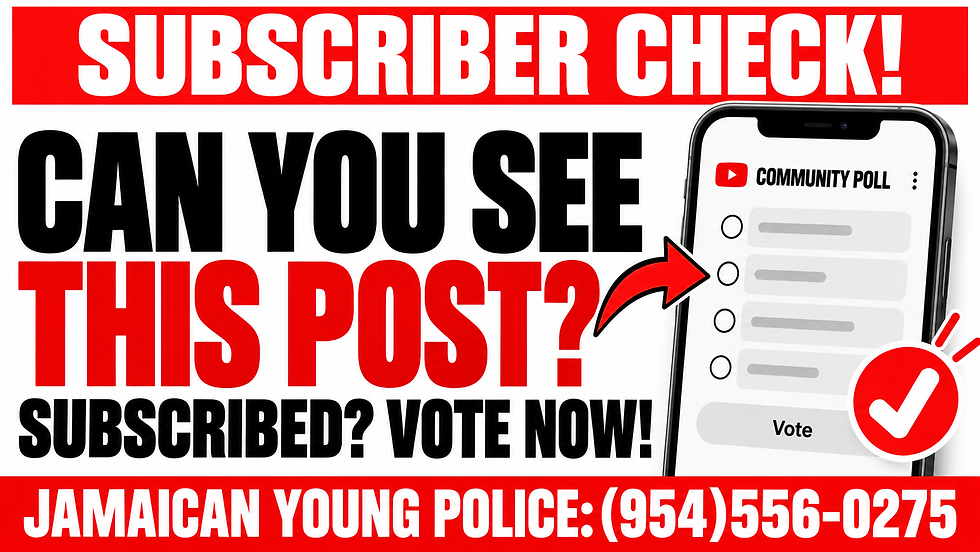
Editorial illustration: this graphic invites participation in a YouTube Community poll. It is an image, not a working voting form.
SUBSCRIBER CHECK — PLEASE VOTE! Are you subscribed to Jamaican Young Police, and do our new videos appear on your YouTube Home page?
Option 1: Subscribed — I see them regularly.
Option 2: Subscribed — I rarely see them.
Option 3: Subscribed — I never see them.
Option 4: I’m not subscribed.
After voting on the channel’s Community poll, tell us how you found it: Home page, notification, channel page, or shared link. Your response helps us understand the experience of viewers who choose to participate.

Editorial illustration: audience experience matters, but voluntary poll responses cannot establish total subscriber reach or prove suppression. People who never encounter the poll cannot vote. Save dated results and compare them with your analytics, keeping these limits clear.
10. Stop making corporate goodwill your only protection
Decency matters. Honesty matters. Morals matter. But your business should have protections that function even when the person handling your complaint is dismissive, mistaken, or unwilling to engage.
You cannot make an accountability system depend entirely on somebody deciding to behave better. Put obligations in writing. Preserve the records. Establish review procedures. Provide remedies where misconduct is proved.
When a company handles complaints responsibly, that should be recognized. When it fails to address documented concerns, creators should have a credible route to independent examination. Where dishonesty is established, a polished public statement should never substitute for accountability.
The principle applies regardless of the corporation’s name or size. The more influence a system has over people’s livelihoods, the stronger the case for clear, enforceable standards governing its business dealings.
Start with the records you can preserve today
Today, preserve your records. Write a timeline. Submit a precise complaint. Seek legal advice where your evidence supports further action. Contact your House representative and both senators. Ask for independent scrutiny and a practical legislative response.
Keep making your content, and keep your public statements accurate. Let your evidence carry the allegations you can support. You may feel that one creator has very little power beside a corporation with vast resources. But one creator can preserve a record. One creator can raise a question that others recognize. One creator can begin a serious campaign for reform.
American creators help build the value these platforms offer. They deserve systems that take their documented business concerns seriously. We should be able to ask difficult questions, examine disputed figures, and pursue lawful remedies without being treated as though requesting an explanation is unreasonable.
Fairness deserves a process. Evidence deserves examination. Established wrongdoing deserves consequences. If you stayed to the end, your code words are: INDEPENDENT ACCOUNTABILITY!
SUBSTANCE OVER POPULARITY! UNITED WE WIN. DIVIDED WE LOSE! YOU WATCH, YOU LISTEN, AND YOU DECIDE!
📞 JAMAICAN YOUNG POLICE: (954) 559-4921
👍 LIKE • 🔥 HYPE • ↗️ SHARE • 💬 COMMENT • 🔔 SUBSCRIBE
A Jamaican Young Police production. The illustrations were created for this commentary and retain the contact details displayed when originally designed; the current contact number appears above. This article advocates reform and does not present falling metrics or voluntary poll results as proof of deliberate misconduct.



Comments