WHO ARE JAMAICA'S REAL CRIMINALS? Dudus Coke, the Gunmen, the Educated Enablers and the Hidden Price of Power

By ExDetective Chris Porter | Jamaican Young Police | Long-form editorial commentary | October 16, 2026
An educational investigation into criminal influence, corruption, gang recruitment and the difference between fear and genuine respect. This article is commentary, not an allegation that every educated Jamaican participates in criminal activity.

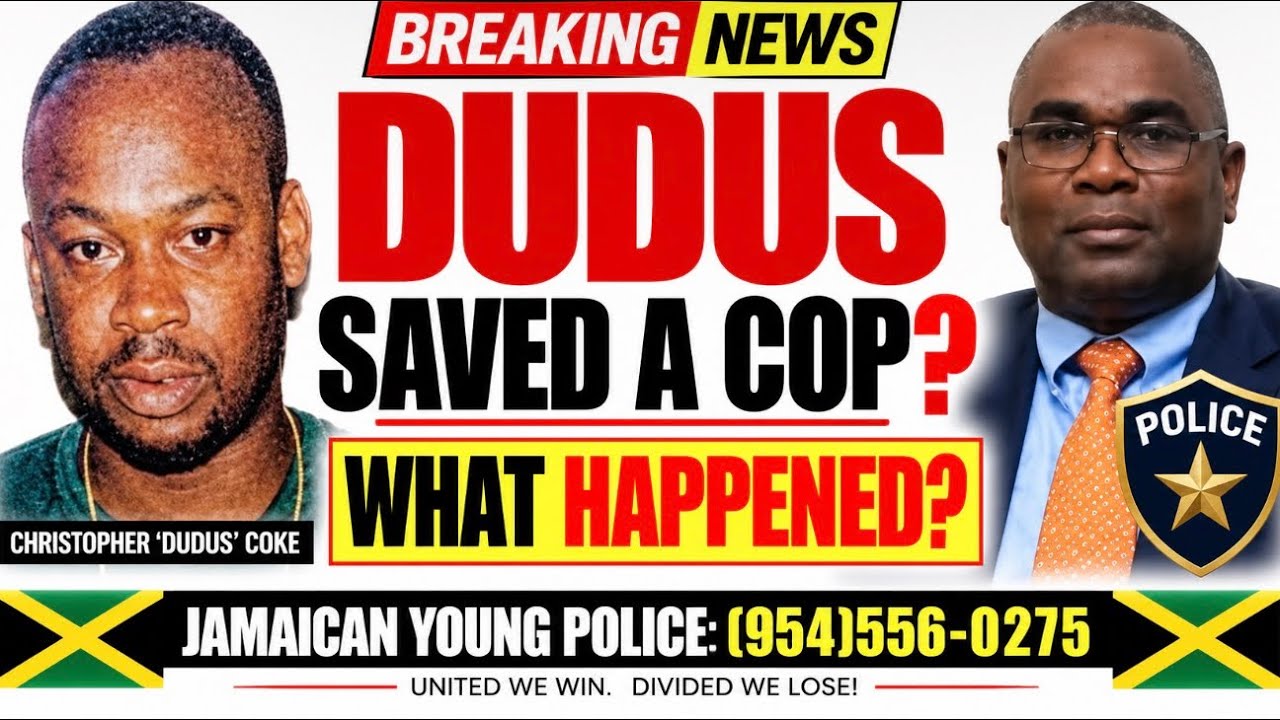
IMAGE DISCLOSURE: The accompanying image is stylized, edited artwork. The green shirt, oversized chain and other graphic elements do not establish what Dudus Coke wore in prison or any specific event.
THE WARNING WE MUST NOT IGNORE
My Jamaican Young Police family, open your eyes and listen carefully. The loudest criminal is not always the person exercising the greatest power. The man carrying a gun may frighten a neighborhood, but who supplied the weapon? Who supplied the money? Who purchased silence? Who opened the door through which illicit profits entered ordinary business? These questions are more important than any glamorous nickname. Our mission is not to trade rumors or worship notorious figures. Our mission is to understand how criminal activity becomes entrenched, who profits, and how ordinary Jamaicans can regain the freedom to live without intimidation.
I speak with urgency because children are watching the adults around them. They notice whom we celebrate. They see the expensive vehicles, the swagger and the public respect sometimes bestowed on men whose reputations are soaked in allegations of violence. But an apparent show of strength is not proof of true independence. A young man may believe he is the master of his territory while depending on individuals he has never met. If we want to save lives, we must teach our children to question the system behind the spectacle.
THE SUIT AND THE GUN: TWO DIFFERENT IMAGES
A gang member may wear a T-shirt and slippers; a financier may wear a tailored suit. Clothing tells us nothing reliable about legal guilt. It is wrong to presume that every educated professional is corrupt, just as it is wrong to assume that every poor young man is a criminal. Nevertheless, sophisticated criminal enterprises often need skills that extend beyond the street: moving money, concealing ownership, procuring supplies, exploiting contracts, and evading scrutiny. The serious investigative question is whether any individual, regardless of social class, knowingly helps a criminal enterprise function.
When I warn about powerful enablers, I am not attacking education. I am defending it. Education should create problem solvers, conscientious public servants and ethical business leaders. Misused expertise can become a tool for fraud and exploitation. The response must be evidence-based investigation, not a blanket accusation against lawyers, accountants, politicians, public employees or people with degrees. Jamaica must be a country where the honest professional is protected and the corrupt professional, if proven guilty, faces the same law as everyone else.
WHY SOME YOUNG MEN CONFUSE FEAR WITH RESPECT
One of the most dangerous lies told in our communities is that being feared means being respected. A boy sees neighbors lower their voices when a particular man enters. He observes people stepping aside. He hears a nickname repeated with excitement. He may interpret that behavior as admiration, when much of it may actually be self-preservation. When people fear retaliation they may smile, agree or remain silent. That is not the same as trust. The young man who builds his identity on fear is building on the most unstable foundation imaginable.
True respect survives disagreement. You can tell a respected teacher that you disagree and still remain safe. You can question an honorable community leader without fearing punishment. A criminal organization frequently treats questioning as disloyalty. This distinction should be taught in classrooms and homes. Ask a child: would you rather have people praise you because you help them, or because they are afraid to cross you? One answer creates community. The other destroys it.
THE HIDDEN MARKET FOR VIOLENCE
Violence does not always begin with a spontaneous quarrel on a street corner. It can arise from competition for illegal profits, control of territory, revenge, intimidation or attempts to protect an illicit enterprise. Some organized groups operate as businesses of coercion, collecting money through extortion and enforcing their demands through threats. That is why focusing exclusively on the person who fires the weapon can be inadequate. Investigators must follow evidence concerning command structures, financing, communications, procurement and possible protection networks.
But we should never jump from this general truth to accusing a named professional or political figure without proof. 'Somebody must be behind it' is a prompt for investigation, not a license to invent a perpetrator. Evidence can include financial records lawfully obtained, corroborated testimony, properly handled communications and judicial findings. A credible anti-gang campaign depends on both courage and restraint. We must be tough on criminality and equally tough on unsupported allegations.
DUDUS COKE AND THE CONSEQUENCES OF CRIMINAL POWER
Christopher Michael 'Dudus' Coke became one of the most internationally recognized names associated with Jamaican organized crime. His name is inseparable from the confrontation surrounding his requested extradition in 2010, the events in Tivoli Gardens, and the questions those events raised about criminal influence and state authority. Coke ultimately went to the United States, pleaded guilty in federal court and received a lengthy prison sentence. That history belongs in any serious discussion of the limitations and consequences of coercive power.
The image accompanying this article depicts Dudus in a dark green shirt, wearing a dramatic gold chain bearing the word 'SHOWER!' It is an edited editorial illustration, not proof of how he dressed in prison or of any particular incident. Look past the visual drama. The lesson is that a feared name cannot guarantee lasting freedom. The bigger lesson is that communities must never again be placed in a position where allegiance to an individual challenges the protections and responsibilities of the state.
THE SHOWER POSSE NAME AND THE REAL HUMAN COST
The Shower Posse name became notorious in discussions of organized criminal activity linked to Jamaica and overseas. Sensational accounts often focus on nicknames, leaders and rivalries. Yet the most important stories belong to the ordinary residents whose lives were constrained by armed intimidation and criminal competition. Think about the student who struggled to get safely to school, the worker who feared a journey home, and the family forced to endure the sound of gunfire. Those experiences are the human cost that catchy headlines can conceal.
We should resist the temptation to transform criminal organizations into folklore or a glamorous entertainment franchise. A nickname may fit on a T-shirt. It cannot capture a mother's grief or a child's anxiety. If you listen to accounts of communities damaged by gangs, you will hear not only about the dead, but also about abandoned ambitions, lost savings, canceled businesses and damaged trust. Anti-criminality education must make those invisible losses visible.
THE QUESTION OF POLITICAL PROTECTION
Jamaica has long debated the relationship between political mobilization, community patronage and armed groups. That history deserves careful study, public access to records and accountable institutions. It is legitimate to ask whether anyone in public life has aided, tolerated or benefited from violence. It is not legitimate to declare an entire political party, every politician, or a specific person guilty without evidence. When political accusation becomes a substitute for proof, criminals can exploit the confusion while public trust weakens further.
My message is the same to every political organization: reject violent patronage, cooperate with lawful investigations and protect voters from intimidation. Do not excuse criminality because the accused person claims your political colors. The victims of criminal violence do not belong exclusively to any party. Their right to safety should unite us. An anti-gang principle that changes according to the party in power is not a principle at all.
THE MAN WHO HOLDS THE GUN MAY NOT HOLD THE POWER
A young recruit might believe the weapon in his hand makes him the most important person in the district. But dependence is not independence. If someone else controls his income, access to supplies or standing in the organization, his apparent power may be conditional. Orders may come from people who never expose themselves to the same street-level danger. His name may be known while theirs remain invisible. That is one reason sophisticated investigations pursue organizers and facilitators as well as direct perpetrators.
Nevertheless, it would be irresponsible to say, as a proven universal rule, that hidden educated people 'decide when to take out' every gunman. Some violence is driven by rivalry, personal disputes, internal factionalism or decisions made by the armed participants themselves. We must investigate each case on its own evidence. The central warning remains powerful without exaggeration: young men who enter criminal organizations often surrender far more control over their futures than they imagine.
EDUCATION SHOULD LIBERATE, NOT EXPLOIT
I love education because it expands human possibility. Reading helps people interpret laws, contracts, news reports and medical guidance. Mathematics helps families budget and businesses grow. Technical skills create careers. Ethical professional training gives a person tools to protect the weak and solve complex problems. That is precisely why it is so distressing when specialized knowledge is used to facilitate wrongdoing. The problem is not education; it is the decision to use education without conscience.
To the young person who hears criticism of powerful elites and concludes that schooling is useless, reject that conclusion immediately. Your community needs more honest accountants, responsible lawyers, thoughtful scientists, principled public servants and courageous investigative journalists. The answer to corruption among a few educated people is not more ignorance among the many. The answer is stronger ethics, fair enforcement, transparent systems and better opportunities to acquire knowledge.
RAGGASHANTI, PUBLIC COMMENTARY AND ASKING HARD QUESTIONS
Public commentators, including Raggashanti, can stimulate valuable discussions about class, influence, social hypocrisy and how crime is portrayed. The Jamaican Young Police audience has been encouraged to revisit commentary and interviews that ask uncomfortable questions. But the fact that a speaker expresses an allegation does not establish that it is true. Whenever a video names someone or attributes wrongdoing to them, the next question should be what records, witnesses or other reliable material support that specific assertion.
That is the kind of independent thinking we should cultivate. Watch the argument. Separate the documented fact from the speaker's interpretation. Compare competing accounts. Understand the context. Then decide what is persuasive. You do not honor Sir Porter, Raggashanti or any other commentator by surrendering your judgment. You honor serious commentary by listening carefully and demanding substance. 'You watch, you listen, and you decide' is a call for critical thinking, not blind loyalty.
THE DIFFERENCE BETWEEN A SOURCE AND PROOF
Suppose someone whispers that a prominent person secretly financed a violent group. The claim may sound plausible, especially if the public already distrusts that person. But what has actually been established? Is there a financial record? A sworn witness? A recorded transaction? A court finding? Or is the allegation simply being repeated? A responsible writer labels those categories accurately. Repetition does not turn speculation into a fact, and a viral post does not carry the authority of a verdict.
This standard protects innocent people and strengthens investigations of guilty people. False accusations can divert attention, prejudice witnesses and allow real offenders to escape scrutiny. Meanwhile, solid evidence can survive challenge and support accountability. Let us demand proof with the same passion we demand justice. Truth is not an inconvenience to anti-crime advocacy. Truth is its most essential weapon.
THE PROBLEM OF FINANCIAL FACILITATORS
Organized criminal proceeds often need a route into the formal economy. Law-enforcement agencies therefore pay attention to suspicious flows, false fronts, nominee ownership and transactions designed to obscure origins. The person who physically collects extortion money may be only one small piece of a larger picture. Financial analysis, when conducted lawfully, can help reveal relationships that eyewitnesses on the street cannot easily observe. This is a reason to support capable financial investigators and independent oversight.
Honest businesses should welcome a fair system that prevents criminal enterprises from buying an advantage through intimidation or laundering. At the same time, suspicion must not become a presumption that every successful Jamaican businessman is secretly a criminal. Fairness requires distinguishing commercial success from criminal transactions. The goal is to punish provable misconduct and protect legitimate economic growth. It is possible to pursue both goals without compromise.
WHAT HAPPENS WHEN SILENCE BECOMES NORMAL
Communities affected by violent groups sometimes develop habits of silence. Residents may decline to report wrongdoing because they worry that information will reach the wrong people, that institutions will fail to protect them, or that their families may suffer retaliation. Condemning those residents without acknowledging the danger is both unfair and ineffective. Cooperation grows when people believe reporting channels are trustworthy and protective measures are real.
That is why the slogan 'Informer fi live' carries a responsibility. Encouraging people to provide information must be accompanied by support for lawful protection, confidentiality where appropriate, and careful handling of sources. Police leaders, prosecutors and elected officials must earn the confidence of communities. The objective is not reckless exposure of vulnerable witnesses. It is a justice system in which citizens can assist investigators without being abandoned to threats.
THE CHILD WHO THINKS THE GUNMAN IS A HERO
Picture a child seeing a famous criminal figure surrounded by attention, expensive accessories and people offering public praise. The child may not hear the accounts of victims. He may not understand the restrictions that fear imposes on neighbors. He sees glamour without its hidden price. This is where parents, teachers and responsible media must intervene. Explain that wealth does not prove wisdom, notoriety does not prove honor and an intimidating reputation does not prove courage.
Ask the child to name someone who improved another person's life this week. Perhaps it was a teacher who stayed late, a mechanic who fixed a vehicle honestly, a nurse who comforted a patient or a neighbor who helped a family after a storm. Those are examples worth amplifying. A healthy society does not need to pretend that crime is boring; it needs to make decency visible and admirable. Role models are chosen one story at a time.
A LESSON FROM THE POLICING PROFESSION
A former detective knows that a crime scene is not a complete explanation of a crime. The visible evidence is the start of a question. Investigators must reconstruct events, establish timelines, test witness accounts, examine possible motives and identify the actual participants. Good police work follows leads without confusing an early theory with an established conclusion. That discipline becomes even more important when the case involves famous names, partisan debate or intense public pressure.
My years of service also taught me that violence can scar a family long after television cameras move on. Our objective should be fewer grieving parents, fewer traumatized children, and fewer officers and civilians exposed to danger. There is no glory in romanticizing a criminal career. The highest achievement is prevention: helping a young person refuse recruitment, supporting a threatened witness, or strengthening an institution before wrongdoing becomes a tragedy.
DO NOT WORSHIP THE STRONGMAN
Political and criminal strongmen sometimes cultivate the illusion that only they can provide security or assistance. People then feel trapped between fear of the strongman and mistrust of institutions. The answer is not to replace one strongman with another. It is to establish services, equal enforcement, and public officials who can be questioned and removed without intimidation. The rule of law must not be negotiable according to popularity.
Look at the difference between authority and domination. Legitimate authority is constrained by procedure and answerable to the public. Domination relies on consequences for disobedience. A community that must seek a criminal leader's permission to enjoy ordinary rights is not truly free. Jamaicans deserve neighborhoods where a child can play, an entrepreneur can trade, and a resident can criticize wrongdoing without begging a private enforcer for protection.
JAMAICA NEEDS INSTITUTIONS, NOT MYTHS
We can honor courageous individual police officers while recognizing that sustainable public safety depends on institutions. Professional investigations, independent courts, accountable corrections, witness protection, effective schools and accessible economic opportunities form an interlocking system. No single commissioner, politician, influencer or journalist can replace these foundations. Heroes may inspire us, but systems protect us when heroes retire.
This is why accountability must apply to high-ranking officials and ordinary citizens alike. A law that operates only against poor defendants is not equal justice. Nor is a system fair if politically connected suspects are condemned in the media without evidence while actual wrongdoing goes uninvestigated. Transparency, judicial independence and rigorous documentation strengthen public legitimacy. They also make it harder for criminal organizations to exploit mistrust.
THE TRUE PRICE OF A CRIMINAL CAREER
The supposed benefits of criminal status are easy to display: cash, jewelry, fast cars and a reputation that makes others move aside. The costs unfold less photogenically: relatives waiting outside prisons, children growing up without parents, lost time, seized assets, damaged health and lives cut short. Even when a criminal figure provides material assistance to a neighborhood, that assistance cannot erase coercion or excuse the harm inflicted on victims.
When discussing notorious names, remember to judge the whole record rather than a carefully selected scene. A necklace and a green shirt can make a striking editorial image; they do not provide evidence of virtue, guilt in an unrelated case, or dominance over anyone else. The measure of a life should be responsibility, service and respect for other people's freedoms. Let us make those values more attractive than the mythology of the gunman.
WHAT THE PUBLIC CAN DO NOW
Families can start by refusing to teach children that intimidation is admirable. Schools can offer media-literacy lessons showing how to test sensational claims. Employers can create pathways for apprenticeships and first jobs. Community organizations can support credible mentors. Journalists can distinguish verified evidence from allegation. Lawmakers can fund independent investigations and protective services. None of these actions alone will solve organized crime, but together they reduce the space in which it operates.
And citizens can demand consistent standards from every political party. Ask candidates how they will protect witnesses, trace illicit finances, reduce recruitment and measure outcomes. Ask for measurable goals rather than merely emotional speeches. Support lawful reporting of criminal activity through safe official channels. Refuse to circulate accusations that have no corroboration. Public courage includes the discipline to say, 'I do not yet know whether that is true.'
WHY LISTENING UNTIL THE END MATTERS
To the Jamaican Young Police audience, I especially commend those who remain with a long presentation from beginning to end. Patience matters because the first dramatic sentence is rarely the whole story. By listening further, you hear qualifications, history, contrary evidence and practical lessons. A thoughtful viewer is not simply looking for a slogan to repeat; that viewer is acquiring tools to evaluate what is being said.
Some supporters express admiration by calling Sir Porter a prophet. I appreciate the affection behind that word, but prediction and analysis should be tested against facts. None of us is beyond questioning. In fact, a presenter who invites the audience to think independently offers more lasting value than one who asks only for praise. Our community grows stronger when loyalty to the truth is greater than loyalty to any personality.
AN APPEAL TO THE JAMAICAN DIASPORA
Those of us living beyond Jamaica's shores still have a role in its future. The diaspora can support educational organizations, mentor young people, invest in legitimate enterprise and press for accountability without sensationalizing suffering at home. It can demand that remittances, philanthropy and business partnerships reinforce independence rather than foster dependence on coercive actors. Love of country is not measured by the harshness of one's words alone; it is measured by constructive contributions.
We must also avoid stereotyping Jamaica's working-class communities. Many residents of neighborhoods burdened by violence are courageous, diligent and deeply committed to lawful lives. Their neighborhoods are not synonymous with gangs. Their children are not destined for crime. Tell stories about entrepreneurship, scholarship, generosity and resilience alongside investigative reporting. A country becomes stronger when the public can imagine and support a future beyond criminal notoriety.
THE SALUTE TO THOSE WHO CHOOSE THE BOOK
Tonight I offer a salute not to the person who terrifies a neighborhood but to the teenager who chooses to study when somebody invites him toward a gang. I salute the worker who refuses an illicit payment, the officer who follows evidence rather than political pressure, the business owner who will not pay to sponsor intimidation, and the parent who teaches a child to ask questions. These are not weak people. They are the builders of a free country.
The promise of an honorable life may not come with glittering necklaces or viral nicknames. But it can deliver a more valuable reward: the ability to sleep in peace, look your family in the eyes and move through your community without relying on fear. If you are young and tempted by the illusion of criminal power, remember that your future is worth more than somebody else's illegal enterprise. Give me the book and not the gun.
THE FINAL MESSAGE: WHO ARE THE REAL CRIMINALS?
The question 'Who are the real criminals?' should never become a contest in which we excuse street violence by blaming powerful people, or excuse powerful wrongdoing by blaming the street. A person who knowingly finances a criminal enterprise is accountable for that conduct if it is proved. A person who commits a violent offense is accountable for that offense if it is proved. Education, poverty, political influence and celebrity neither automatically establish guilt nor grant immunity. Equal accountability is the only coherent answer.
So I ask every reader to stop confusing appearances with truth. Follow evidence. Reject fear. Defend due process. Protect witnesses. Demand answers from institutions. Give young Jamaicans legitimate paths forward. Remember the human beings who carry the burden of violence. And whenever you see a glamorous portrayal of a notorious figure, ask what the image leaves out. This is the Jamaican Young Police challenge: substance over popularity; informer fi live; united we win, divided we lose. You watch, you listen, and you decide!
Read, watch and decide
For broader discussion see the Jamaican Young Police video: https://www.youtube.com/watch?v=InQl7Tl6aLg . This earlier video addresses a separate prison confrontation allegation; it is not evidence of the specific claims discussed in this editorial.
Jamaican Young Police | (954) 556-0275 | Substance over popularity! United we win. Divided we lose! You watch, you listen, and you decide!


Comments